Backhand Technique for Beginners
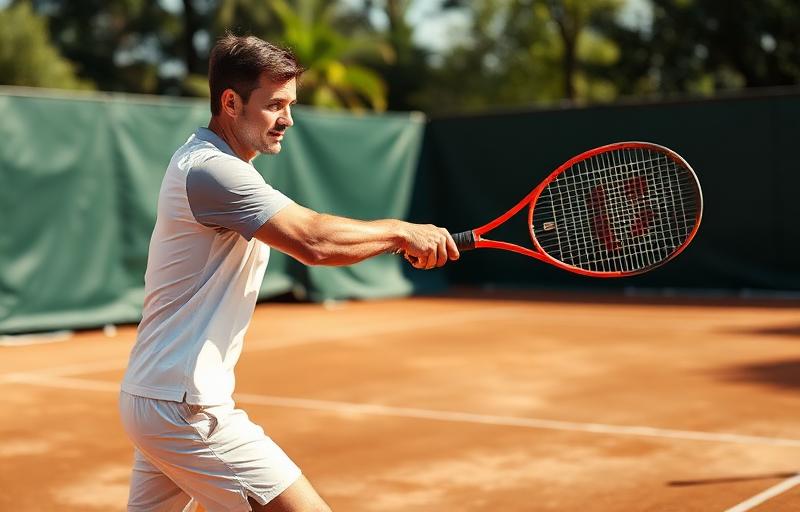
Hello, future champions and passionate tennis enthusiasts! Today, we're diving into the world of one of the most elegant, yet demanding, strokes – the backhand. If you're just starting your journey on the court, this article will be your go-to guide for backhand technique, revealing all its secrets and helping you master it from scratch. We'll cover everything from the correct grip to the finishing phase of the stroke, and also learn how to use modern technologies to analyze your game.
Why is the backhand important for every tennis player?
The backhand is often called the "mirror" of your tennis skill. For many beginners, it seems more complex than the forehand, but believe me – mastering proper backhand technique opens up endless possibilities on the court. It allows you to effectively respond to the trickiest opponent shots, control rallies, change the pace of the game, and even finish points with powerful winners. Without a confident backhand, you will always give an advantage to your opponent by avoiding your "weak" side.
Fundamentals of Backhand Technique for Beginners: Where to Start?
Before we get into the details, let's understand that the foundation of any stroke in tennis is the correct base. It's like the foundation of a house – you can't do without it.
Backhand Grips
Choosing a grip is the first and often the most important step. There are different backhand grips, depending on whether you play a one-handed or two-handed backhand.
One-handed backhand
- Continental Grip: This grip is the basis for many strokes and can be used for a one-handed backhand, especially for slices. However, for a flat or topspin one-handed backhand, it's too uncomfortable.
How to take it:* Lay the racket flat in front of you, as if you're shaking its hand. Guide the V-shaped groove between your thumb and index finger to the top left bevel of the handle (if you're right-handed).
- Eastern Backhand Grip: The most common for beginner players using a one-handed backhand. It's easy to learn and allows for both flat and topspin shots.
How to take it:* Rotate the racket one bevel from the continental grip. The V-shaped groove will now be on the top face of the handle. This position provides a larger racket face at contact with the ball.
- Semi-Western Backhand Grip: A more aggressive grip for a one-handed backhand, allowing for more spin and power.
How to take it:* Rotate the racket one more bevel from the Eastern grip. The V-shaped groove will be on the top right bevel of the handle. Requires a stronger wrist and developed shoulder blade.
Two-handed backhand
The two-handed backhand is the most popular choice for beginners due to its stability and ease of learning.
- Bottom hand: Usually uses a continental or semi-western grip.
- Top hand: For right-handers, this is the left hand, and it usually takes a grip like a forehand (Eastern or semi-western), but for the left hand.
How to take it:* The right (bottom) hand takes a continental grip. The left (top) hand is placed on top of the right as if you were going to hit a forehand with your left hand with an Eastern grip. This creates a powerful and stable platform for the stroke.
Tip for beginners: If you're just starting, consider the two-handed backhand. It gives more control and power at the initial stage.
Preparation: Stance and Backswing
Proper preparation is 80% of a successful stroke.
- Ready position: Always hold the racket with both hands, elbows slightly bent, feet shoulder-width apart, knees slightly bent. You should be ready to move in any direction.
- Shoulder turn: When you see the ball approaching your backhand side, immediately begin to turn your _shoulders_ and torso. Your arms stay with your body. This is a critically important movement that sets the foundation for the entire stroke.
- Racket take-back (backswing): The racket is taken back, shoulders and hips fully turned towards the net. For a two-handed backhand, both hands take the racket back. For a one-handed backhand, the non-hitting arm is often used to guide the racket back and then releases it.
Important:* The backswing should be relaxed and natural. There's no need to swing too far back or too low – this will lead to loss of control and slow down the stroke. Imagine you are "loading a spring" in your body.
Contact with the ball: The most important moment
This phase is the culmination of all preparation.
- Contact point: The ball should be hit in front of you, at arm's length (or slightly closer for a two-handed backhand). Don't let the ball bounce too close to your body.
- Racket face: The racket face should be as perpendicular to the court as possible at the moment of impact for a flat backhand, slightly angled up for topspin, and slightly angled down for a slice.
- Weight transfer: During contact with the ball, you should transfer your body weight from your back foot to your front foot. This generates most of the stroke's power.
- "Hitting window": Hit the ball in the "window" – between the ball's drop zone and its highest point, most likely at waist level or slightly higher.
Follow-through and Finish
After contact with the ball, the stroke doesn't end.
- Follow-through: After hitting the ball, the racket continues to move forward in the direction of the target. This provides control, stability, and adds power.
- Finish: For a one-handed backhand, the racket usually finishes its movement around the body, wrapping around the neck, or high over the opposite shoulder. For a two-handed backhand, both hands finish their movement over the opposite shoulder.
- Recovery: Immediately after completing the stroke, you should be ready for the next rally. Return to the central ready position, maintaining balance.
Types of Backhands for Beginners
As you master the basic technique, you can start experimenting with different types of shots.
Flat Backhand
This is the most direct and powerful shot. The ball travels on a relatively straight trajectory. Ideal for deep, stable shots.
Topspin Backhand
Allows the ball to drop faster while maintaining speed, making it more difficult for the opponent to return. Adds control and depth.
- Key: Racket movement from low to high through the ball.
Slice Backhand
Used to change the pace of the game, hit drop shots, or for defense. The ball travels low and with backspin.
- Key: Racket movement from high to low under the ball.
Practical Exercises for Mastering Backhand Technique
Theory is good, but practice is essential! Start with these exercises to solidify the basics.
Exercise 1: Shadow Swings (without a ball)
- Goal: Develop muscle memory and correct movement mechanics.
- How to perform: Stand in the ready position. Slowly execute all phases of the backhand: turn, backswing, imitation of contact with the ball, follow-through, and finish. Focus on smooth and sequential movements. Repeat 10-15 times per set.
Exercise 2: Backhand at the Net (or against a wall)
- Goal: Practice ball contact and follow-through.
- How to perform: Stand 2-3 meters from the net (or wall). Toss the ball to yourself with your hand and try to execute a backhand, focusing on the correct contact point and a long follow-through. Try to hit the ball over the net or into a specific area of the wall.
Exercise 3: Backhand with a Partner (or Coach)
- Goal: Playing in real conditions, coordination, control.
- How to perform: A partner (or coach) throws you a ball for your backhand, standing on the same side of the court. Your task is to send the ball back over the net. Start with easy throws, gradually increasing speed and difficulty. Then move on to hitting from a bounce from the hand or from the opposite side of the court.
Exercise 4: Weight Transfer and Balance
- Goal: Reinforce correct weight transfer.
- How to perform: Stand with your feet slightly wider than shoulder-width apart. Mimic the backhand swing, transferring weight to your back leg. Then, mimicking the hit, smoothly transfer weight to your front leg, maintaining balance. You can perform this exercise with a ball, paying attention to the feeling of weight.
Exercise 5: Video Analysis of Your Technique
- Goal: Objective assessment and identification of errors.
- How to perform: Ask a friend or coach to film you while performing a backhand from different angles (side, back). Carefully review the video, comparing your technique with ideal examples.
Common Mistakes for Beginners When Performing a Backhand
Knowing mistakes is half of correcting them!
- Insufficient body rotation: Often, beginners "lazily" rotate only their arms, not their shoulders and entire torso. This deprives the stroke of power and stability.
- Hitting too close to the body: Leads to loss of control and power. The ball should be hit in front of you.
- Short follow-through: The stroke is "cut off" immediately after contact with the ball. This reduces accuracy and power.
- Gripping the racket too tightly: Your hands should be relaxed to allow for free racket movement. You only need to squeeze the racket at the moment of contact.
- Incorrect footwork: You should be constantly moving, approaching the ball in such a way as to get into the correct hitting position.
- Looking away from the ball: Many look away from the ball at the moment of impact, which leads to inaccuracy. Try to "glue" your eyes to the ball until contact is complete.
The Role of AI Analysis in Improving Your Backhand Technique
In the 21st century, tennis training is incomplete without technology. Modern AI systems are becoming indispensable assistants in honing skills. How does it work?
You record a video of your game or a specific shot, such as a backhand. Then you upload it to a specialized application. AI analyzes your every movement:
- Body position: Correct shoulder turn, foot placement.
- Arm work: Backswing angle, racket face at the contact point, follow-through.
- Weight transfer: How effectively body inertia is used.
- Timing: Synchronization of movement with the incoming ball.
An AI coach can identify errors that are not obvious to the human eye, suggest specific exercises to correct them, and even show ideal movement models for comparison. This allows for instant, objective, and personalized feedback, accelerating the learning process and making it much more effective.
Tips from a Professional Coach
Patience and consistency are your best friends
Mastering the backhand (and tennis in general) is a marathon, not a sprint. Don't get discouraged if something doesn't work out right away. Every stroke is an experience.
Watch the pros
Study how your favorite players execute their backhands. Pay attention to their footwork, preparation, hitting angle, and finish. Don't try to copy completely, but use it as a source of inspiration.
Always warm up
This will prevent injuries and prepare your muscles for exertion. Include dynamic stretches and light hitting in your warm-up.
Work on overall physical fitness
Strong legs, core, and shoulders are the key to a powerful and stable backhand. Include strength, endurance, and flexibility exercises in your training program.
Find a coach
Even with the capabilities of AI, an experienced coach will give you personal adjustments, motivation, and help you progress faster. The combination of working with a coach and AI analysis is the ideal formula for success.
Conclusion
Mastering backhand technique for beginners is an exciting yet demanding endeavor. Step by step, from grip to finish, you will feel the ball flying more obediently to the desired spot on the court. Remember the key principles – body rotation, correct contact, and a long follow-through. Use exercises, correct common mistakes, and don't forget that modern technologies can significantly accelerate your progress.
Your journey to a confident and powerful backhand is just beginning. Good luck on the court!
---
Want to get a personal analysis of your technique? Upload your video to playbettertennis.app and get an analysis from an AI coach →
Related articles
-
Mastering Serve Speed 180 Tennis: Your Step-by-Step Guide to a Dominant ServeDreaming of hitting a powerful 180 km/h serve? This comprehensive guide breaks down the essential techniques, exercises, and drills to significantly increase your serve speed. Unlock your potential and add serious pace to your game.
-
Serve Speed 180 Tennis: A Step-by-Step Guide to a Powerful ServeDreaming of a serve flying at 180 km/h? This step-by-step guide will help you understand the technique, physics, and training to significantly increase your tennis serve speed.
-
Mastering the Alcaraz Serve Tennis: A Step-by-Step GuideCarlos Alcaraz's serve is a masterclass in modern tennis. This guide breaks down his powerful technique, offering actionable steps to improve your own service game. Discover the biomechanics and drills behind one of the fastest serves on tour.
-
Alcaraz's Serve in Tennis: A Step-by-Step Guide to Dominating the CourtLearn how to improve your tennis serve by analyzing Carlos Alcaraz's technique. This guide will help you achieve maximum efficiency and power. Follow our step-by-step instructions.